What Happens if It Rains on Your Wedding Day?
Listen instead of reading (21 min). Two hosts walk through this post, what a real rain plan needs, when to make the call, and what to say to your guests.
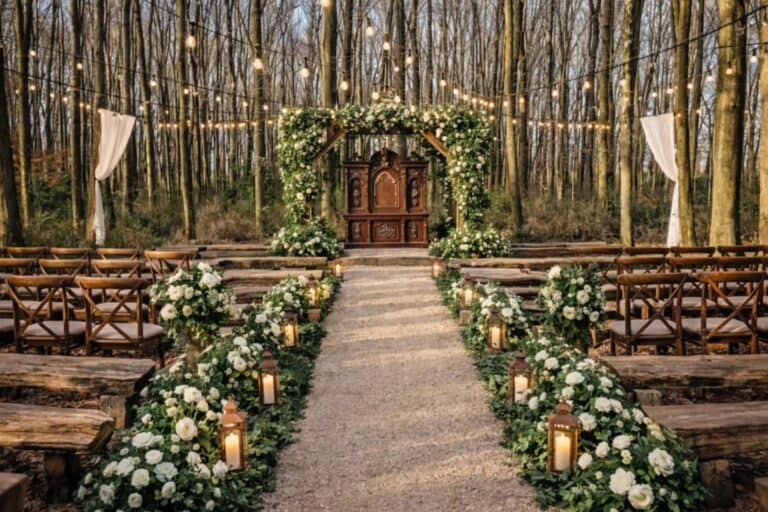
You pictured the ceremony outside. The oaks behind you, the field going gold, everyone squinting into the late light. Then the ten day forecast turns, and the question shows up in a group chat at eleven at night. What happens if it rains?
The short answer is that nothing falls apart. A rain plan is not a consolation prize. It is the other half of a well built wedding day, and at a venue that has a real one, most of your guests will never know there was a plan A. The longer answer matters more, because whether a wet wedding feels calm or frantic is almost always decided months earlier, on a tour, in a conversation nobody thought was important at the time.
A rain plan is a place, a deadline, and a crew
Couples hear the words rain plan and picture a tent. What you actually need is three things, and a venue either has all three or it has a nice sentence.
First, a covered space that holds your whole guest list seated, not standing along a wall. Second, a deadline, a specific hour on the wedding day when the decision gets made and stops being reopened. Third, a crew, meaning named people who move the chairs, the sound, and the flowers, and who are not your family in wedding clothes.
If you ask about rain and the answer is we would just move it inside, keep asking. Inside where, holding how many, set up by whom, decided when.
Ask these questions before you sign
Bring this list to every tour. Write the answers down while you are standing there, because four venues later they blur together.
- Does the covered space seat every guest, or is it standing room once you pass a certain number?
- Is the rain plan included in the rental, or is it an added fee on the day you need it most?
- Who physically sets it up, venue staff or my vendors and my family?
- How long does the switch take, and by what time does the call have to be made?
- If the ceremony moves into the covered space, where does cocktail hour go while the room is reset?
- Is there a covered path from parking to the door, and where do guests wait if they arrive early?
- What happens to the send off, the shuttle, and the photo spots we liked?
Those questions belong on the same page as everything else you carry into a tour. If you are still building that list, our guide to what to ask on a wedding venue tour covers the rest of it.
Who makes the call, and when
You make it, with your venue and your coordinator telling you what they are seeing. It happens earlier in the day than most couples expect, because setup has to happen once, not twice.
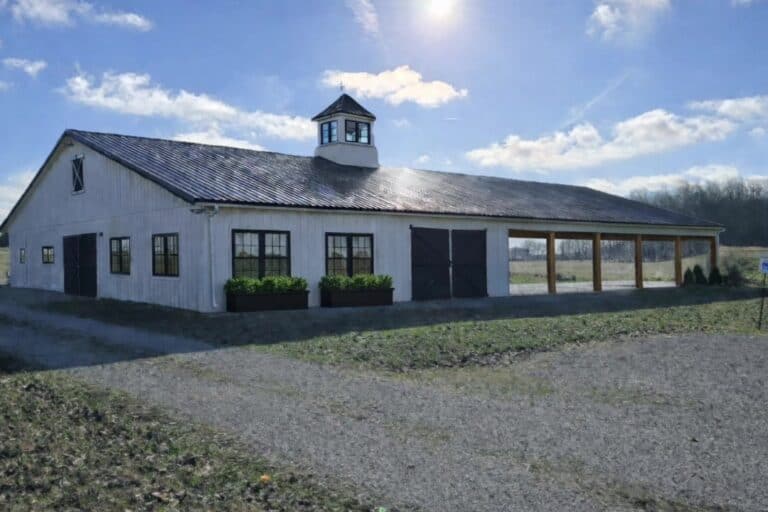
Here, staff sets the barn for your reception or an indoor ceremony the morning of your wedding and has everything finished by noon. The get ready spaces open at nine. So the honest window for a decision is the morning, not four o’clock while your guests are parking.
Pick your hour in advance and say it out loud to your people. We decide at ten. Then decide at ten, and stop refreshing the radar. Couples who keep the question open all day spend their wedding morning on their phones instead of with their friends, and the forecast rarely rewards them for it.
What actually changes on a rainy wedding day
Less than you think. Guests arrive a little earlier and go straight to a dry seat instead of milling around the lawn. The timeline tightens because nobody is walking as far. Portraits move under cover, or they wait, because a wet morning very often opens into a soft grey light in the late afternoon that photographers quietly love.
What does not change is the part you are there for. The vows are the same vows. The first dance is the same dance. Your grandmother still cries. Rain takes away a view, not a wedding.
Give your vendors one message, not five
Once the call is made, it goes out once, in one thread, with a time stamp. Photographer, coordinator, caterer, florist, and whoever is running music all need the same sentence. Ceremony is in the barn, guests seated at four thirty, load in under the covered end.
Five separate texts from five different family members is how a vendor ends up setting up in the wrong place. Name one person to send it, and it should not be you.
What to tell your guests, and what to skip
Guests take their cue from you. If the first thing they hear is an apology, they will spend the evening telling you it is fine. If the first thing they hear is a plan, they will hang up their coats and go find the bar.
Tell the wedding party and immediate family directly, because they will be asked. Put one clear sign at the entrance. If parking or the walk changes, send that in the morning group text with the actual instructions. You do not owe anyone a weather update at midnight the night before.
Small things that make a wet day easier
- A basket of plain white or clear umbrellas by the door. Clear ones keep faces visible in photos.
- Towels near the entrance, and a mat that is actually big enough.
- A second pair of flat shoes for you and anyone in a long dress.
- Bins or crates so cords and card boxes are never sitting on damp ground.
- A hair plan that survives humidity, and someone assigned to carry the hem.
- A shuttle or a drop off order if the walk from parking is long.
None of that costs much. All of it is the difference between damp and miserable.
How rain works at Highland Oaks
Our rain plan is the barn. It has a beautiful covered space that keeps guests dry and comfortable, and it is built to hold the celebration we would have set out in the field. Highland Oaks hosts up to three hundred guests, on thirty-six acres at 4175 US-150 in Palmyra, Indiana, about twenty-five minutes from Louisville.
Peak season here runs April, May, and September through November, which is also when southern Indiana weather is at its most opinionated. A seventy degree Saturday in October can arrive behind a morning of rain. That is exactly why the covered space is part of how we set every wedding, not an emergency measure we go looking for.
You can see what is included with the property on our pricing page, and the rest of the common questions live on our FAQ.
Come see it before you need it
The best time to look at a rain plan is on a dry afternoon with a year to spare. When you tour, ask to stand in the covered space and picture your ceremony in it. Tours run about forty-five minutes and we walk the whole property, so bring the list above and make us answer all of it.
Weather is the one part of your wedding nobody gets to choose. The plan for it, you do.
Episode transcript
So picture this. You’ve, you have been planning this day for well over a year. Oh, at least a year, usually more. Right. And you have perfectly pictured your outdoor wedding ceremony. Like you know exactly how it looks. The grand oak trees right behind you. The open field turning that perfect shade of golden yellow. Yeah, that idyllic autumn look. Exactly. The weather is completely crisp. The sun is shining. And absolutely everyone you love is squinting just a little bit into that gorgeous, warm, late afternoon light. It’s flawless. It’s the ultimate Pinterest board come to life. It really is. But then you check your phone and the 10 day forecast has shifted. Oh, no. Yeah. Suddenly there is a little dark cloud icon and a percentage of precipitation that just keeps creeping up every time you refresh the app.
Yeah. And right on cue, the late night panic texts from your bridal party start rolling in. The dreaded group chat. Yes. The group chat is just buzzing at 11 at night. And everyone is asking the exact same terrifying question. Yeah. What happens if it rains? It is like the absolute quickest way to send a couple into a total tailspin. Oh, totally. Because you are so heavily emotionally and financially invested in a very specific vision, right? And suddenly this totally uncontrollable variable just enters the chat. Yeah. And you can’t do anything about it. Exactly. The instinct is to panic because, I mean, for most people rain feels like a complete cancellation of the dream. Well, the weather honestly does not care about your Pinterest board. So, okay, let’s unpack this. Today, we are taking a deep dive into an incredibly practical, deeply insightful guide provided by Highland Oaks weddings and events.
Right. Out in Indiana. Yeah. They are venue located in Palmyra, Indiana. And they have basically written the definitive manual on this exact scenario. They really have seen it all. They have. So our mission for this deep dive is to take their expertise and figure out exactly how to bulletproof an outdoor wedding against unpredictable weather. You know, so you aren’t the one having a breakdown in the group chat at midnight. I think we have to start by establishing the guiding philosophy of this entire Highland Oaks guide, because it completely flips the script on how most people view a rainy wedding day. It’s a total mindset shift. It really is. The core thesis here is that a rain plan is not a consolation prize. Right. It is not some tragic backup option that you are just forced to settle for. A proper rain plan is actually the other half of a well-built wedding day. Like it’s baked into the DNA of the event. Exactly. Whether a rainy wedding feels, you know, calm and seamless or totally frantic and chaotic,
that is almost never decided on the actual morning of the wedding. Oh, wow. So when is it decided? It’s decided months and months earlier, usually during a venue tour in this super casual conversation that nobody even thought was all that important at the time. See, that brings us to a huge misconception, because when a lot of couples hear the phrase rain plan, they instantly picture like a really flimsy, sad white tent just getting battered by the wind in a muddy field. Right. Just holding onto the poles for dear life. Exactly. Or they tour a venue and they ask about rain, and the venue coordinator just kind of waves hands and says, oh, don’t worry if it rains, we’ll just move it inside. Which is such a red flag. It’s a massive red flag. A venue telling you we’ll just move it inside without giving you any specifics is, well, it’s like an airplane having a safety manual that just says, try not to crash. That is a perfect way to put it. Right. It doesn’t actually tell you how to survive the emergency. It just kind of acknowledges that
an emergency might happen. Yeah. And the guide makes it explicitly clear that a real rain plan requires three mandatory components like non-negotiable. Okay. What are they? A physical space, a firm deadline, and a dedicated crew. And if a venue does not have all three of those firmly established and documented, they literally do not have a rain plan. So let’s break those down. The physical space. Let’s look at the physical space first. The covered space must be able to seat your entire guest list. That is the critical distinction here. Not just shove everyone in a room. Right. Not just fit them inside the building to satisfy a fire code, but actually seat them comfortably for a ceremony. Because there is a massive difference between a venue saying, we can bring everyone inside and a venue actually giving everyone a chair. Oh, night and day. If they just like clear a dance floor and pack everyone in, what they really mean is that a third
of your guests will be left awkwardly standing along a back wall. Just peering over shoulders, trying to see anything. Right. Trying to see you exchange vows. And it fundamentally changes the guest experience from a beautiful intimate ceremony to, I mean, a crowded subway ride at Rush Hour. It creates an immediate sense of discomfort. You have to remember guests are in formal wear they are often wearing heels or holding heavy coats or wet umbrellas. And now you’re asking them to stand for 45 minutes. It’s just miserable. Okay. So that’s the place. What about the crew? The second component is the crew. And this means there are named dedicated venue staff members whose actual job is to physically move the chairs, transport the sound equipment, and you know, relocate those heavy floral arrangements. Yeah. And the guide warns about the alternative here. And it is a nightmare scenario.
Because if the venue doesn’t supply the labor, who does? It always falls on someone. Exactly. And it ends up being your family. And it absolutely cannot be your family members in their expensive wedding clothes, sweating and hauling folding chairs across a damp lawn an hour before the ceremony. Nobody wants to see their uncle doing that. Right. Your uncles and cousins are there to celebrate you, not to act as unpaid roadies in formal wear. Letting guests or family act as venue staff creates instant resentment and chaos. And actually the same applies if a venue expects your other vendors, like the catering staff or the florist, to suddenly become furniture movers. Oh yeah. They have their own jobs to do. Exactly. And this ties directly into a major financial trap that couples really need to be aware of. Yes. The hidden fees. Right. You have to ask the venue point blank. Is this rain plan, like this covered space and the staff to set it up,
is it actually included in the base rental fee? Or is it a surprise added fee that gets tacked on at the very last minute? Because being charged extra to not get rained on feels a little like extortion when you’re already stressed out. It really does. Imagine waking up to a thunderstorm and getting a text from your venue that it will be, you know, an extra $2,000 to open the barn doors. What’s fascinating here is the sheer logistical domino effect that a lack of planning triggers, because a rain plan is never just about moving the ceremony from the grass to the indoors. Right. Everything is connected. Exactly. If the ceremony suddenly moves into the reception hall, you have to ask the venue, where does the cocktail hour go while that room is being reset? Because a room flip takes significant time. I mean, the catering team needs an hour to roll out the dinner tables, set the silverware, and arrange the centerpieces.
They can’t do that with people standing there. No. You can’t have 150 guests just standing around and avoid, while waiters are sprinting past them with stacks of chairs. A functional venue will have a secondary space, like a covered veranda, a large foyer, or even a secondary tent, specifically designated for that cocktail hour buffer. That makes so much sense. And those dominoes just keep falling. You have to ask if there are covered paths from the parking lot to the door, what happens to the shuttle drop-off points? Oh, I wouldn’t have even thought of the shuttles. Right. If guests arrive 30 minutes early and it’s pouring outside, are the doors open for them? Or are they trapped in their idling cars? What happens to those specific outdoor photo spots you loved? Right. These are all the granular questions that have to be asked while you are standing on the venue tour, looking around on a totally dry afternoon. But you know, even if a venue has the space and the dedicated crew and all that infrastructure
mapped out, none of it actually matters if nobody knows when to pull the trigger. That is so true. Which introduces the real psychological warfare of a rainy wedding morning. The Highland Oaks Guide identifies the deadline as the absolute pivot point of the entire day. The deadline is really where the rubber meets the road. The call to move everything inside is ultimately made by the couple, usually guided by what the venue staff and the wedding coordinator are seeing on the ground. Right. But the critical takeaway from the source is that this decision happens way, way earlier than most couples expect or even want it to. Because setup has to happen once, not twice. Exactly. You cannot set up a field with 300 chairs, realize it’s raining at two in the afternoon, and then scramble to tear it all down and reset the barn. The logistics of that double setup are impossible for any crew to handle.
So what is the honest window for making this call? It basically has to happen in the morning. 10 o’clock is usually the cutoff. Wow. That early. Yeah. For context, at Highland Oaks, the get ready spaces for the wedding party open at nine in the morning. The staff there is required to have the barn completely set for either the reception or an indoor ceremony by noon. Okay. I have to push back on this strict timeline on behalf of anyone who has ever planned an event. Fair enough. Because weather changes constantly, especially in regions like the Midwest. Shouldn’t the couple hold out hope until the absolute last possible second? I hear this all the time. Right. Like if there is even a 10% chance the sun peaks out at three 30, shouldn’t they wait to make the call? You plan for the beautiful outdoor oak trees. You know, you should fight for the oak trees. The urge to wait is incredibly strong. I completely agree.
But the guide systematically dismantles that exact mindset. They actually call it the radar trap. The radar trap. I like that. Yeah. Because if you as a couple keep that question open all day long, just hoping for a meteorological miracle, you end up spending your entire wedding morning glued to your phone screen. Oh, that’s so sad. You were sitting in the bridal suite or the groom’s room, missing the champagne, missing the inside jokes, completely detached from your best friends. Exactly. Just watching a little green and yellow blob move across a digital radar. Right. The psychological weight of that ambiguity is exhausting. You’re basically burning all your emotional energy before the wedding even starts. And the harsh truth is the forecast rarely rewards you for that anxiety. So what’s the alternative? The guide’s advice is definitive. Pick the hour in advance.
Tell your people we decide at 10 a.m. And then when 10 a.m. hits, make the call, say it out loud, and critically stop looking at the app. Just put the phone away. Yes. The relief of a final decision almost always outweighs the disappointment of the rain. That makes total sense. Once you make the call, the ambiguity is gone. You can actually start enjoying your wedding day again, even if it’s plan B. You’re back in the moment. Exactly. Now here’s where it gets really interesting. Because the guide lays out incredibly strict rules for communication once that 10 a.m. deadline passes. It’s vital. It’s treated like a military operation to prevent absolute chaos from breaking out behind the scenes. Information is incredibly fragile on a wedding day. Let’s look at vendor communication first. The rule from the source is absolute on this. One message in one thread with a timestamp.
No room for confusion. Exactly. You do not leave room for interpretation or assumptions. You give them exactly what they need to know in a single definitive sentence. A message like, ceremonies in the barn, guests seated at 430, load in under the covered end. Boom. Done. Perfect. Because if you don’t do that, you end up playing the worst, most expensive game of telephone imaginable. I can just picture it. Oh, it happens all the time. The bride’s mom texts the florist that things are moving. The groom’s brother texts the DJ to go to the barn. The maid of honor tells the caterer something slightly different. And suddenly your caterer is setting up a carving station in the mud while the DJ is frantically plugging extension cords into a wall in the barn. It’s a disaster. It is. Every single vendor needs to see that exact same definitive sentence.
And the guide adds a very crucial caveat to this single message rule. The couple should not be the ones hitting send. Oh, delegate it. Yes. You nominate one trusted person, a coordinator, or a highly organized friend to send that text. The couple’s job is to relax, not to act as air traffic control. Okay. So that handles the professionals who are used to pivoting. But what about the guests? That’s a whole different story. Right. Because they see the rain out there, living room windows. They’re wondering what’s happening and they start texting you. The source has this brilliant psychological insight regarding how to manage your guests. Yeah. They explicitly state, do not apologize to your guests. It understands human dynamics perfectly. Guests take their emotional cues entirely from the couple. Right. If you project anxiety or disappointment, the guests will mirror that anxiety and disappointment. If the first thing a guest hears from you or your family is,
we are so sorry about the rain. It’s ruined everything. I’m so sorry you have to be inside. You are forcing them into a really awkward position. You really are. The guest is now obligated to spend the entire evening trying to comfort you. They have to keep saying, oh, no, it’s fine. Really, it’s beautiful. And here, don’t be sad. You basically turn your guests into your therapists. And that totally drains the celebratory energy out of the room. It totally does. The alternative is to confidently lead with a plan, which shifts the psychology entirely. You say the ceremony is in the barn and it’s cozy and dry. Grab a drink. Just own it. Yeah. If that is the first thing they hear, they will simply hang up their wet coats and go find the bar. They want to celebrate, you know. You just have to give them permission to do so without worrying about your feelings. Practically speaking, this means skipping the midnight mass texts, updating everyone on the barometric pressure. Please don’t do that.
Right. The guide suggests telling the immediate family directly, because they are the ones who will inevitably be bombarded with questions by other guests. Put one very clear, large sign at the entrance of the venue directing traffic. And if you have to, send one simple morning text to the guest list. If the parking situation or the walking paths have changed, just keep it strictly informational. All of this grand logistics and psychological maneuvering eventually trickles down to the granular day of detail. The little things. Yeah, because there is a very fine line between a day that feels damp and miserable and a day that feels incredibly cozy and beautiful. The guide actually recommends a specific survival kit of physical items that a venue or a couple should have on hand to make a wet day easier. The survival kit stood out to me because these are surprisingly inexpensive items that make a
massive difference. The first one they mentioned is having a basket of umbrellas by the door, but they specifically highlight clear or plain white umbrellas. Clear is vital for a very technical reason. It keeps the couple and the guest’s faces totally visible for the photographer. Right. Lighting is everything. It is. A black umbrella creates a literal cave of shadow over a person’s face. It essentially blocks the light from hitting the camera sensor. Exactly. And if the photographer has to crank up their camera settings to expose a dark face under a black umbrella, the background gets blown out or the photo turns out incredibly grainy. You are actively ruining a $5,000 photography package by using a golf umbrella with a giant logo on it. Which nobody wants. Clear umbrellas act as like tiny transparent greenhouses that let the natural light pour in.
The second item in the kit is towels near the entrances and a genuinely large heavy-duty mat. Not a cute little mat. No. A tiny decorative welcome mat isn’t going to dry 50 pairs of dress shoes. And you do not want 50 pairs of wet leather soles walking onto a polished wood dance floor. It turns the entire reception into a total slip and slide. It’s super dangerous. The guide also points out the need for a second pair of flat comfortable shoes for the bride and anyone wearing a long dress. Oh, because of the mud. Right. Heels sink into wet grass instantly, anchoring you to the ground and ruining the shoes. You also need a hair plan that is designed to survive humidity like an up-do rather than loose curls that will fall flat in 20 minutes. That makes total sense. And someone must be explicitly assigned to carry the hem of the wedding dress whenever you
are walking outside so it doesn’t act like a mop and just waterlog. There was one rule in there about dealing with the damp ground that I thought was just a stroke of tactical genius. Which one? The advise using plastic bins or wooden crates to elevate specific items. Electrical cords for the band or DJ and the card box where guests leave envelopes. Oh, absolutely. You never want those sitting directly on a damp floor or wet ground. A card box full of checks soaking up puddle water is a financial disaster. Nobody wants soggy checks. Right. And wet electrical cords are a literal hazard that could shut down your entire reception. It’s such a small detail, but it literally saves the day. And this level of preparedness really reflects the reality of the venue providing the guide. Highland Oaks. Yeah. The Highland Oaks sits on 36 acres in southern Indiana. They can host up to 300 guests and they’re located just a short 25-minute drive from Louisville.
So they handle large significant events. But their peak wedding seasons are April, May and September through November. Those are beautiful months. But as the guide perfectly phrases it, that is when southern Indiana’s weather is at its most opinionated. Opinionated is a very diplomatic word for wildly volatile. It really is. In that region, a gorgeous 70-degree Saturday in October can easily be preceded by a morning of torrential rain. The weather turns on a dime there. It’s so unpredictable. Exactly. This is exactly why Highland Oaks designed their rain plan the way they did. Their barn isn’t an emergency backup shed they go looking for when things go wrong. It is a beautiful, dedicated space built to hold the exact same scale and style of celebration you would have had outside in the field. It’s standard protocol.
If we connect this to the bigger picture, what actually changes on a wet wedding day? Like when you really zoom out and look at the event as a whole, what is fundamentally different? Shockingly little. The reality is that a rainy day just tightens the timeline. Nobody is walking as far. Guests arrive from their cars, they walk a shorter distance, and they go straight to dry seats instead of milling around a massive lawn for 45 minutes. And the guide points out an incredible silver lining here, specifically regarding the photography. Couples usually assume rain ruins the photos, but wet mornings very often give way to a very specific, soft, gray, late afternoon light. Oh, it’s stunning. Wedding photographers quietly love this light. They do because direct harsh sunshine is actually quite difficult to shoot in. It makes everyone sweat, it makes people squint, and it creates harsh, dark shadows under the eyes
and nose. Like raccoon eyes. Exactly. That soft, overcast light acts like a giant natural diffuser. It makes the colors of the floral arrangements pop and gives everything a really romantic, cinematic quality. The portraits, whether they are moved under a covered patio or delayed slightly until the afternoon, often turn out much better than they would have on a perfectly sunny, cloudless day. It’s a huge hidden bonus. So what does this all mean? We’ve covered the three pillars of a real rain plan, the psychology of setting a firm morning deadline, how to communicate like a professional to avoid a logistical disaster, and the tactical survival kit that keeps everyone safe and dry. That’s a lot of ground to cover. It is. But for you listening, preparing for a big day, the ultimate takeaway is pretty empowering. You absolutely cannot control the weather, but you can control the plan.
And a good plan protects the core of the event. I love the way this source phrases this at the end of their guide. They write, rain takes away a view, not a wedding. That’s beautifully said. Think about that. The vows you say to each other are the exact same vows. The first dance is the exact same dance. The food tastes the same. Your grandma is still going to cry in the front row. You just happen to be doing all of it with a roof over your head instead of oak trees. It’s a beautiful distillation of what actually matters. You know, analyzing all of this leaves me with a broader thought about the whole endeavor. Oh, I’d love to hear it. Well, the guide rightly emphasizes that weather is the one part of a wedding day that nobody gets to choose. It is totally outside your jurisdiction, totally uncontrollable. But it makes you wonder. When you are standing at the very starting line of a marriage, just facing and successfully managing a totally uncontrollable,
unexpected element right out of the gate actually set a healthier tone for your partnership. Oh, wow. That’s a really interesting way to look at it. If you can navigate a stressful pivot, communicate clearly with each other and still find the joy in a day that didn’t go exactly as drawn up, doesn’t that prepare you better for a lifelong partnership? Then a day where absolutely everything goes perfectly according to a rigid itinerary. Because life, like the weather, rarely sticks to the plan. Exactly. A little adversity on day one might just be the best foundation you can ask for. Thank you so much for joining us on this deep dive. Next time you’re perfectly picturing that golden field and squinting into the late light, remember, even if the clouds roll in with the right plan, the day is still entirely yours. Stay curious and we’ll see you next time.
Weighing whether to keep everything in one place? Read should your ceremony and reception be at the same venue for how a single property simplifies the rain plan.
Planning a wedding near Louisville?
Highland Oaks is a barn wedding venue in Palmyra, Indiana, a short drive from Louisville. Come walk the grounds and picture your day. Tours take about 45 minutes, with no pressure.
Book a TourPrefer to talk it through first? Call or text (502) 785-9671.